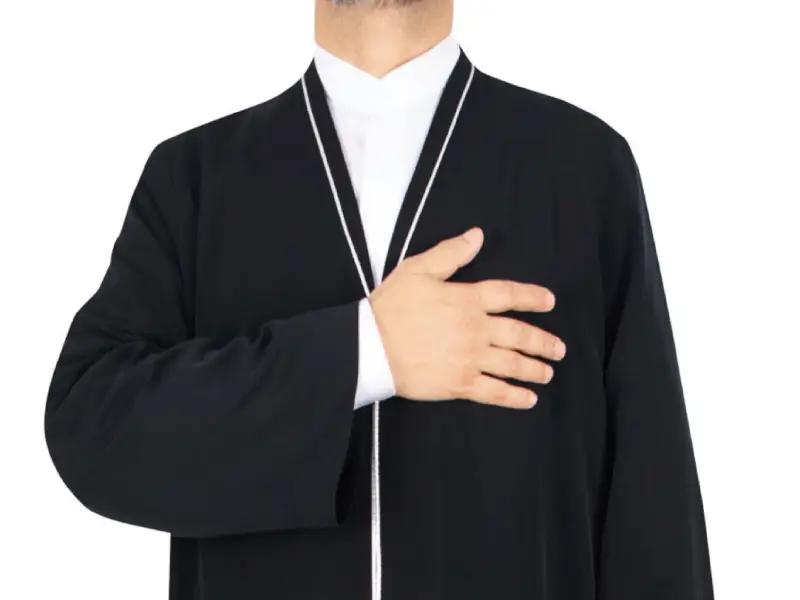
What is a cleric? Is there a class of scholars in Islam?
ISLAM IS NOT A RELIGION WITH A CLERGY (RELIGIOUS MAN) CLASS
It is known that ‘ruhban’, the plural of the Arabic word ‘rahib’, comes from the root ‘rahbe’ and ‘rahbaniyya’. Rahbe means: fear and apprehension, suffering due to deep religious anxieties, rahbaniyy means: dedicating oneself to worship with intense religious anxiety and fear. Rahib, on the other hand, refers to a person who fears Allah and worships in seclusion.541
It is known that priesthood, which emerged later as a concept, especially within Christianity, was accepted as an attitude desired by Allah from humans. While Prophet Jesus did not bring such a religion to people, the Quran draws attention to the priesthood invented by people for the purpose of gaining Allah’s pleasure, and how many of those who invented it deviated from the path by failing to adhere to what they invented: Then We sent Our (other) messengers after them; and We sent Jesus, son of Mary, after them and gave him the Gospel, and placed compassion and mercy in the hearts of those who followed him. But monasticism is something else… They invented it for themselves, though We did not enjoin it upon them, their motive being to seek Allah’s pleasure; but they did not observe it with due observance… In the end, We gave those of them who believed their reward; but many of them deviated from the path. (Hadid 27) The religion, which was taken out of what Allah had revealed to Prophet Jesus and transformed into Christianity, widely perceived through the hands of “religious men”, losing its essence, and institutionalized with this new form, saw the authority of the Messiah, accepted as the head of the Church, pass to the apostles, and from them to “religious men”; “religious men” in a sense became sacred figures representing God’s authority on earth and were excessively glorified by people, becoming an indisputable authority.
The verses point out that the rabbis and priests who emerged over time among the followers of Prophet Jesus as a result of the priesthood invented by people, despite not being part of the religion, took them as lords besides Allah, whereas they were commanded to worship only Allah, who is the sole deity: They have taken their rabbis and monks as lords besides Allah, and the Messiah, son of Mary, as well. Yet they were commanded to worship none but one God, Allah. There is no god but He. Exalted is He above what they associate with Him. (Tawbah 31) When some people took rabbis and priests as lords instead of worshipping Allah alone, most rabbis and priests, empowered by their status as “religious men”, began to exploit the people and accumulate wealth: O you who have believed! Indeed, many of the rabbis and monks devour the wealth of people unjustly and avert [them] from the way of Allah. And those who accumulate gold and silver and do not spend them in the way of Allah – give them tidings of a painful punishment. (Tawbah 34) However, in true Islam, no one has the authority to represent Allah’s religion. Allah has not appointed any person or group as His representative. Religion is the common ground for people. No one has more rights or authority than another regarding religion. Undoubtedly, understanding and living Allah’s religion in the most correct and beautiful way is the primary duty of every believer.
One must learn what they do not know, consult those they think know, evaluate everyone and every opinion, and ultimately review their beliefs and acceptances according to their intellect, nature, and of course, Allah’s revelation and the lives of the prophets who are examples for believers by acting with revelation. At this point, it is beneficial to look at the issue through the thoughts of the famous scholar Muhammad Abduh: “Abduh very clearly stated that Islam not only rejected religious authority but eradicated its traces completely. In fact, the most important principle brought by Islam is to demolish this principle. Islam has not given anyone after Allah and His Messenger the right to dominate another’s belief and exert pressure on their faith. Even the Messenger of Allah is not a controller or oppressor, but only a messenger and a Warner. In Islam, there is no authority other than advising good and striving to distance from evil. This authority is not assigned to a specific class but is given to all Muslims collectively. Therefore, no one has the power to “bind” and “loose” on earth or in heaven, other than giving advice and guidance.”542 Thus, there is no religious official. There is a religious volunteer. An official looks at their defined responsibilities as a job to be done and fulfilled. A volunteer, on the other hand, acts with a dedicated spirit, sincerity, and earnestness. There is no doubt about the necessity of volunteerism, sincerity, earnestness, and dedication in every work involving religion and faith, and that the reward should be expected only from Allah. One should take as an example the principled stance adopted by all prophets when conveying Allah’s verses to people: And know this: if you turn away, remember that I did not ask you for any reward for my call; my reward is due only from Allah; for I was commanded to surrender myself unconditionally to Allah. (Yunus 72) These verses were not revealed as historical information, but as a warning for us, the followers of the final revelation, so that we do not fall into the same mistakes. In Islam, there is no “clergy” class. Everyone is obliged to be a man of their religion, meaning a virtuous and principled believer who fulfills religious requirements in the best possible way.
A Muslim can be a man of the universal values that religion has put forth, in accordance with human intellect and creation, not a clergyman. In Islam, there is no one who cannot be questioned besides Allah: He (Allah) cannot be questioned about what He does, but they are always questioned. (Anbiya 23) Prophets are not clergymen either. They are individuals of high moral character chosen by Allah and honored with the task of being messengers. They are superior humans, but not superhuman. They are exemplary figures who do not claim ownership in the name of religion, but strive to fulfill the task they received from Allah in the most excellent way: (O Prophet!) Say: “I am only a human being like you (a mortal human). It is revealed to me that your God is one God. So, turn to Him and seek forgiveness from Him! Woe to those who associate divinity with other than Allah!” (Fussilet 6) This is why Islam is a revelation-centered religion, not a prophet-centered one. Prophets are beautiful examples of the revelation brought to life. Prophets serve as examples; they do not partake in the religion. They do not transform Allah’s religion into a different form than it is. In matters of religion, they do not follow anything other than what Allah has revealed.
In the Quran, the Prophet is commanded to say that he only follows what is revealed to him from Allah: When you do not bring them a verse, they say, ‘Why don’t you compile it from here and there?’ Say: I only follow what is revealed to me from my Lord. This (Quran) is insights from your Lord, a guide, and a mercy for a people who believe. (A’raf 203) This verse clearly shows that the Prophet’s speeches outside the Quran are not divine. If everything the Prophet said was a revelation from Allah, the verse would not say: When you do not bring them a verse… If every word from the Prophet’s mouth was a revelation from Allah, unbelievers would not distinguish between what the Prophet said in daily life and the Quran, and they could not criticize the Prophet for not bringing a new verse. This verse shows that the Prophet conveyed only the verses of the Quran as revelation to people. On the other hand, it is necessary to avoid making the religion, which Allah has made livable, unlivable for people and to seek refuge in Allah from falling into such an error. The verses draw attention to this undisputed truth: Does the Creator not know? For He penetrates everything with His knowledge, He is aware of everything. (Mulk 14) Undoubtedly, Allah knew best what He created, just as He knew everything best. Only Allah could write the prescription for what man truly needs, what would appeal to his intellect and heart, and what would enable him to live in a manner befitting human dignity. Man, who strives to exceed his creation capacity by not being content with Allah’s prescription, first acts contrary to his creation. Then he declares as forbidden what Allah has not forbidden, and as prohibited what He has not prohibited. As stated before, the name of the religion brought by all prophets is Islam. There can be no change in Allah’s way and method, or in His fundamental commands and prohibitions that are in accordance with our intellect and creation.
No prophet brought a religion of monasticism. This worldly life is neither a place of trial or suffering for the believing person, nor is it a place where one should forbid oneself things that Allah has made lawful. Religion has come to add meaning and value to human life and to make life easy and livable. Allah does not ask His servant for anything beyond his capacity of creation, nor has He forbidden the moderate and responsible enjoyment of the pure and beautiful blessings He has created, within the bounds of what is lawful. Furthermore, as a requirement of His mercy, Allah desires ease for us, not hardship, and obliges us with an easy, livable religion: Allah intends ease for you, and He does not intend hardship for you. (Baqarah 185) Therefore, Allah does not want us to withdraw from the world, but rather to lead a good, beautiful, and meaningful life as sensitive and virtuous individuals, by acting moderately in what He has made lawful, without forgetting our duties and responsibilities towards Him and His creation: So, enjoy the lawful good things that Allah has provided for you, and be conscious of your responsibility towards Allah in whom you believe. (Ma’idah 88) To desire things within the lawful bounds and to benefit from the beauties of life is quite natural. Because Allah has created all the beauties in life. As expressed in a Persian saying: “If Allah did not want to give, He would not give the desire to ask.” The important thing is to know how to be moderate in what we desire and value, staying away from excesses, and not placing our personal desires above Allah’s desires. Therefore, the real issue is not to kill the self, but to keep the self under control and desire what is good and beautiful. For a person to be tested, their self must have certain desires. It is not possible to test a self whose desires have been killed. The beautiful and pure blessings enjoyed within the limits set by Allah are for everyone in this worldly life, but in the hereafter, they will be exclusively for believers: Say: Who has forbidden the beauty of Allah which He has produced for His servants and the good [lawful] things of provision? Say: “They are for those who believe during the worldly life [but] exclusively for them on the Day of Resurrection.” (A’raf 32) In some understandings, it is said that for a person to struggle with their self, they must kill their self. Even people who forbid themselves an extremely lawful and ordinary blessing just to not pamper their self are praised. However, the Quranic verses do not give us the message to kill our self, but rather the message to know the transience of worldly life and the reality of death, but to see the truths before dying and to be resurrected. Because the Quran does not kill, on the contrary, it gives life and resurrects: O you who have believed, respond to Allah and to the Messenger when He calls you to that which gives you life. (Anfal 24) Not purifying one’s self from evil leads to the deification of the self. Allah does not want us to kill our self, but to control it with a strong will, that is, to dominate it. Because as a requirement of the test, the self is made inclined to jealousy and selfish desires: Souls are inclined to jealousy and selfish desires. But if you do good and fear Allah, then indeed Allah is ever acquainted with what you do. (An-Nisa 128) The self, or ego, itself is not inherently bad. What is bad is the inability to control the self and to do things that Allah would not be pleased with. Allah did not create the self as evil. It is man who pollutes his self by distorting its nature. The verses draw attention to this truth: (By the soul) and [by] Him who proportioned it, and inspired it [with discernment of] its wickedness and its righteousness, he has succeeded who purifies it. And he has failed who corrupts it. (Shams 7-10) To suppress the self or to get rid of desires by forbidding something that Allah has not forbidden is, in the Quranic expression, to transgress the limits: O you who have believed, do not prohibit the good things which Allah has made lawful for you and do not transgress. Indeed, Allah does not like transgressors. (Ma’idah 87) One must live Allah’s religion as Allah deems appropriate.
To those who attempt to teach Him the religion He Himself revealed, our Lord says: Are you teaching Allah your religion? While Allah knows what is in the heavens and what is on earth. Allah knows everything very well. (Hujurat 16). …Say: Are you informing Allah of something He does not know in the heavens or on the earth? (Yunus 18) Since Allah is the owner of the religion, Allah is also the determiner of its rules and laws.
To declare something lawful by Allah as unlawful, and something unlawful by Allah as lawful, is to slander Allah: Say: What is [the matter] with you that you make unlawful a part of what Allah has sent down to you as provision and lawful [another part]? Say: Has Allah permitted you, or are you inventing a lie about Allah? (Yunus 59) For a person who truly believes and wishes to live their faith in the most beautiful way, undoubtedly the main consideration is the afterlife. However, this priority should not overlook the fact that worldly life is, in a sense, the field of the hereafter, and that we should not forget our share of the lawful and pure provisions and blessings that Allah has created: And seek, through what Allah has given you, the home of the Hereafter; but do not forget your portion of the world, and do good as Allah has done good to you. And do not seek corruption in the land. Indeed, Allah does not like corrupters. (Qasas 77) Islam is a religion of moderation and balance. What every person who sincerely submits to Allah should ask from Allah are the good and beautiful things of both this world and the hereafter: And among the people is he who says, “Our Lord, give us in this world!” And he will have in the Hereafter no share. But among them is he who says, “Our Lord, give us in this world [that which is] good and in the Hereafter [that which is] good and protect us from the punishment of the Fire.” (Baqarah 200-20
Source:
Work Title: What Islam Is Not?
Author: Emre Dorman







Post Comment
You must be logged in to post a comment.